
Transparency: this article contains affiliate links. If you sign up through them, Finanzas en Holanda may earn a commission at no extra cost to you. We only recommend products we would use with our own money. More information.
Congratulations, you have your baby in your arms! But before you dive headfirst into the bubble of nappies and sleepless nights, know that in the Netherlands, a bureaucratic clock starts ticking. Punctuality is law here, and registering your baby is no exception: you have 72 hours for the most important procedure of their new life. I’ll tell you everything you need to do, in order and without stress.
1. The Clock is Ticking: Registration at the Gemeente (72 hours)
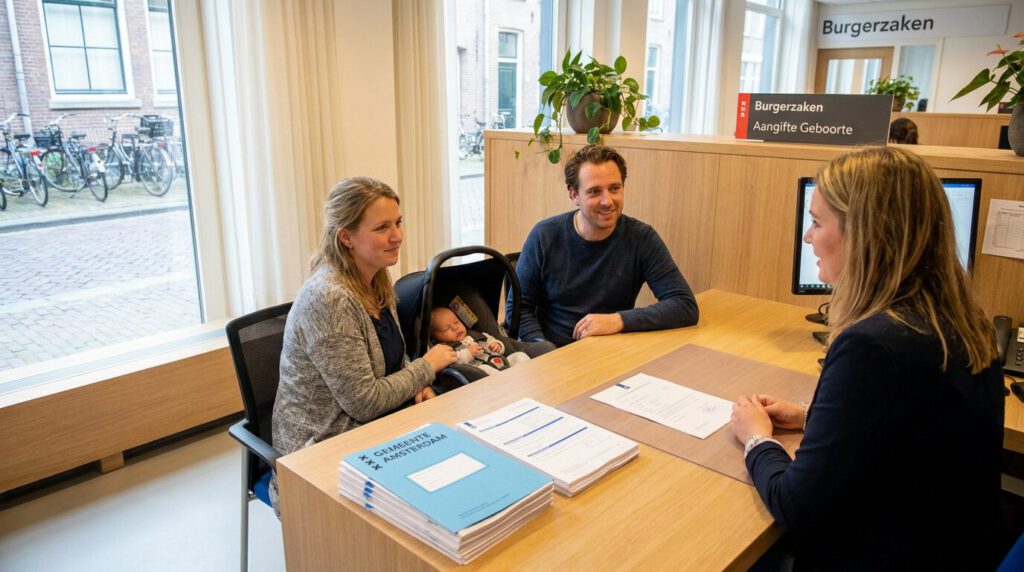
This is the most urgent step. By law, you must complete the aangifte van geboorte (declaration of birth) within three working days following the birth. Be aware: the day of birth does not count, and weekends and public holidays can shift the deadline (the law always guarantees at least two working days).
Where? At the Gemeente (city council) of the city where the baby was born, which is not always where you live. If you live in Utrecht but gave birth in an Amsterdam hospital, you register them in Amsterdam.
Who goes? Normally the father, mother, or the mother’s partner. If, due to force majeure, none of them can go, the law allows someone who was present at the birth to do it (doctor, midwife, or a family member).
What to bring?
- Your identity document or passport (and your partner’s).
- The provisional birth certificate from the hospital or the midwife (verloskundige).
- Your marriage certificate or the erkenning document (acknowledgement of paternity) if you are not married.
- The family book, if you wish to register them in it.
Once completed, the Gemeente registers the child in the Basisregistratie Personen (BRP) and provides you with their Burgerservicenummer (BSN). This number is the key to everything else.
2. Health Insurance: You Have 4 Months, But Do It Now
One of the wonders of the Dutch system: healthcare for children under 18 is covered free of charge. But it doesn’t activate automatically. You need to register the baby with your zorgverzekering (or your partner’s) within the first 4 months of life.
Tip: don’t wait. Do it the same week you receive the BSN. If you miss the 4-month deadline and the baby needs medical attention, you’ll pay the bills out of your own pocket — and a hospital here isn’t cheap. The process is online, using your DigiD: they only ask for the baby’s name, date of birth, and BSN, and it’s added free of charge to the parent’s policy with the best coverage. If you are still comparing insurance providers, check out our guide to health insurance in the Netherlands.
3. The Kinderbijslag: How and When to Apply
The kinderbijslag is the quarterly child benefit received by all resident parents, regardless of their income. In 2026, it ranges from €295.07 per quarter (0 to 5 years) to €421.53 (12 to 17), increasing with the child’s age.
A common mistake: many people believe it’s automatically deposited when you register the baby. No. It’s paid by the SVB, and a few weeks after registration, you’ll receive a physical letter inviting you to apply for it. You log into the SVB website with your DigiD, confirm your bank details, and start receiving payments every quarter. If the letter hasn’t arrived by the time the baby is one month old, apply proactively yourself so you don’t miss out on payments. You can find this alongside other benefits in the most common benefits in the Netherlands.
4. The Insurance Many Latin Americans Forget: Civil Liability
It’s not as common in Latin America, but in the Netherlands, it’s essential: the aansprakelijkheidsverzekering (family civil liability insurance). Here, you are legally responsible for any damage your children cause. Imagine your little one, already crawling, knocks over the neighbour’s new TV or scratches a car with their buggy: without insurance, you pay.
The good news: it’s very inexpensive — it usually costs between €3 and €5 per month for the whole family and covers claims of a million euros or more. You just need to inform your insurer that your family situation has changed so they can add the baby, usually at no extra cost.
5. The Baby’s Financial Future: Starts Day One
From the moment they’re born, you have 18 years ahead to put compound interest to their advantage. Two practical ideas:
Grandparents’ Gift. It’s common for family in Latin America to want to send money for the baby. Don’t let banks eat it up with bad exchange rates and fees: with Wise, you receive it at the real exchange rate and with full transparency.
Put the Kinderbijslag to Work. Instead of leaving that money losing value in an account earning 0%, for the short term (the next clothing size, a car seat), an interest-bearing account like Trade Republic gives you interest on cash. And if the plan is a university fund for when they turn 18, opening an investment account for children with low-cost index funds is the best option — time is on your side.
Checklist for New Parents
- ☐ First 72 hours: register the baby at the birth Gemeente and obtain the BSN.
- ☐ First week: register them with your health insurance.
- ☐ First month: respond to the SVB letter and apply for the kinderbijslag.
- ☐ First month: inform your civil liability insurance provider.
- ☐ First few months: set up savings/investments for their future.
By taking care of these procedures quickly and efficiently, you can concentrate on what truly matters: enjoying your baby. Do you have any questions about any of these steps, or was your experience with the Gemeente different? Tell us in the comments.