
More and more Latin Americans in the Netherlands are taking the leap to work for themselves: designers, programmers, translators, care workers, construction workers, caterers. Becoming a sole trader here—what they call a ZZP’er (zelfstandige zonder personeel, self-employed without employees)—is surprisingly straightforward administratively, but there are several things you should understand before starting to avoid nasty surprises with the Tax Authorities or being left without protection.
This is the complete guide: what it means to be a sole trader in the Netherlands, how to register, what taxes you pay, what deductions you are entitled to, and how to protect yourself. It’s a starting point; each section links to a more detailed guide.
What does it mean to be a sole trader (ZZP) in the Netherlands?
A ZZP’er is a self-employed person, without employees. In practice, most sole traders in the Netherlands operate under the simplest legal structure: the eenmanszaak (sole proprietorship). You don’t need initial capital or a notary to set it up, and your business income is taxed as personal income.
The eenmanszaak is ideal for starting out, but it has an important nuance: you are personally liable for the business’s debts. If your activity involves high risks or you expect to generate a lot of revenue, you might be interested in a BV (limited company). We cover that decision in detail in its dedicated guide, but for most people starting out, the eenmanszaak is the way to go.
Step 1: Register with the KVK
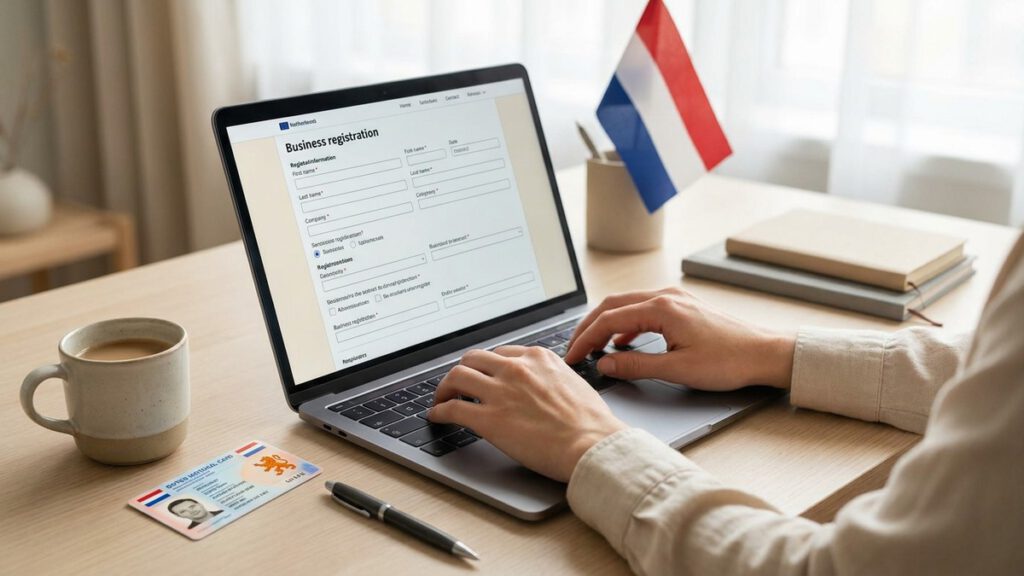
It all starts by registering with the Chamber of Commerce (Kamer van Koophandel, KVK). It’s an in-person registration process by appointment, and in 2026 it costs €85.15 (a one-off fee, and it’s a deductible expense). You need your identification number (BSN), a valid identity document, and a registered address in the Netherlands.
Once registered, the KVK shares your details with the Tax Authorities (Belastingdienst) and, if your activity is considered business-related for VAT purposes, you will receive your VAT number (btw-id) by post within a few days. With that, you can legally issue invoices.
👉 Read the step-by-step details in our guide: how to register with the KVK as a sole trader.
Step 2: Understand your taxes
As a sole trader, you broadly pay two types of taxes:
- VAT (BTW): usually 21% (or 9% in some sectors). You charge it to your clients and declare it quarterly. If you invoice less than €20,000 per year, you can opt for the small business exemption (kleineondernemersregeling, KOR) and not charge VAT.
- Income tax (inkomstenbelasting): on your business profit, as part of your annual tax return (Box 1). This is where sole trader deductions come into play.
The great tax advantage for sole traders in the Netherlands lies in deductions, provided you meet the hours criterion (urencriterium): dedicating at least 1,225 hours per year to your business. If you meet this, you are entitled to:
- The self-employed deduction (zelfstandigenaftrek): €1,200 in 2026 (this figure has been progressively decreasing for years).
- The starter’s deduction (startersaftrek): an extra deduction during your first years as a sole trader.
- The SME profit exemption (mkb-winstvrijstelling): 12.7% of the profit is tax-exempt.
👉 All the details, with calculation examples, in: taxes for sole traders in the Netherlands. And if you want a general overview of the system, read the income tax system in the Netherlands.
Step 3: Manage your bookkeeping
The Tax Authorities require you to keep your administration (invoices, expenses, VAT returns) for 7 years. You don’t need an accountant from day one, but an organised system is essential. Most sole traders use an invoicing and accounting software (boekhoudprogramma) that automates VAT declarations and saves you hours and errors.
Step 4: Protect yourself (what almost no one tells you)
This is the most overlooked and most important part. When you are a sole trader, you no longer have the safety net of an employee: if you get ill or have an accident and can’t work, there’s no salary continuing to come in. That’s why it’s advisable to consider:
- Occupational disability insurance (AOV): covers your income if you cannot work due to illness or accident. It’s not mandatory, but for a sole trader whose income depends on their work, it’s the most relevant protection. We cover it in depth in the AOV insurance guide for sole traders.
- Business liability insurance: protects you if your work causes harm to a client or a third party.
- Your pension: as a sole trader, you don’t automatically accrue a company pension, so you have to build it yourself. Check out our guide to pensions for sole traders with BrightPensioen.
It’s also worth checking which insurances are mandatory and which are recommended in the Netherlands for your situation.
Step 5: Separate your finances
It’s not legally mandatory for an eenmanszaak, but opening a separate business bank account (zakelijke rekening) greatly simplifies your bookkeeping and VAT declarations: all business-related transactions go in and out of a single account. It’s one of the first things we recommend doing after registering with the KVK.
Can I become a sole trader if I am a foreign national?
It depends on your residence permit:
- EU/EEA citizens: no restrictions, you can register as a sole trader directly.
- Non-EU citizens: you need a residence permit that allows you to work as a self-employed person. Some permits (such as partner/family permits) already allow this; others require a specific self-employment permit. Check your situation with the IND before registering.
Summary: your checklist to get started
- Confirm that your residence permit allows you to work as a self-employed person.
- Register with the KVK (€85.15) and receive your btw-id.
- Open a separate business account.
- Choose an accounting software and start invoicing.
- Take out your AOV insurance and liability insurance.
- Record your hours (target: 1,225) to access deductions.
- Start building your pension.
Being a sole trader in the Netherlands is accessible and, when done right, fiscally advantageous. The key is to start with organisation: registration, taxes, protection, and pension. In the guides linked at each step, we break everything down.
This article is for informational purposes only and does not constitute tax or legal advice. For your specific situation, consult with the KVK, the Belastingdienst, or an advisor.
Are you thinking of becoming a sole trader or have you already taken the plunge? Tell me in the comments where you are in the process, and I’ll help you.
As a freelancer you do not build an employer pension, so it is worth understanding how the Dutch pension system works and what you need to cover yourself.