Did you know that from January 2026 in the Netherlands, they can pay you for charging your electric car at home? This is not a marketing trick or an unusual offer. It’s an official system of the Dutch government that forces fuel companies to compensate their emissions, and you could get part of that money.
Transparency: this article contains affiliate links. If you sign up through them, Finanzas en Holanda may earn a commission at no extra cost to you. We only recommend products we would use with our own money. More information.
If you have a charger (laadpaal) at home and an electric car, this interests you. I’ll tell you how it works, how much you can earn, and which companies offer it.
The Law That Makes It Possible to Get Paid
Since January 1, 2026, the Brandstoftransitieverplichting (Fuel Transition Obligation) has been in effect in the Netherlands. This law obliges fuel companies that sell gasoline and diesel to prove they are reducing CO₂ emissions, or else pay a fine.
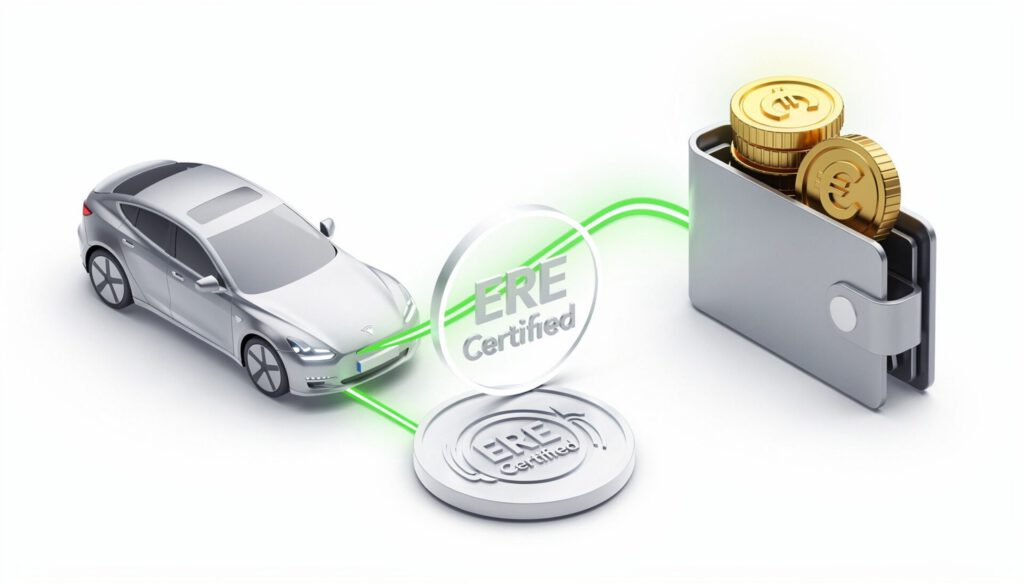
How do they reduce their emissions? By buying ERE certificates (Emissiereductie-eenheden, or units of emission reduction). Each certificate represents 1 kilogram less of CO₂ compared to fossil fuel. And these certificates are generated by people like you, every time you charge your electric car at home.
In other words: gas stations and fuel distributors pay you indirectly for each kWh you charge. It’s kind of like Shell or Total having to give you money for not using their gasoline.
How the System Works Step by Step
- Charge your electric car at home with your laadpaal
- Your charger automatically records the kWh charged
- An intermediary company (inboekdienstverlener) converts these data into ERE certificates
- These certificates are sold to fuel companies
- You receive the money from this sale, minus the intermediary’s commission
Everything happens automatically once you register. You don’t have to do anything special every time you charge.
How Much Money Can You Earn?
The price of ERE certificates fluctuates according to the market, but in 2026 it’s around 10 cents per kWh charged. To give you an idea:
- If you charge 40 kWh per week → about 2,080 kWh per year → approximately €208 per year
- If you drive more, most participants earn between €200 and €500 per year
It’s not a fortune, but it’s also not bad for something you’re already doing. It’s money that used to stay in the pockets of oil companies.
Important: The money goes to the electricity contract holder (EAN-registratie). If the light is in your partner’s or roommate’s name, they will receive the payment, not you.
Tips: Besides registering for ERE certificates, check your electricity tariff. If you pay less per kWh charged, the net benefit increases. With Pricewise Energie you can compare offers from different providers in minutes — it’s free and shows the best available tariffs in your postal code.
What Do You Need to Participate?
There are two main requirements:
- A charger with an MID-meter integrated: It’s a certified meter that officially records how many kWh actually enter the car. Note: An external meter in the electrical panel won’t work; it has to be integrated into the charger itself. Brands like Alfen, Easee, EVbox, Wallbox, and Zaptec generally include this, but check the technical specifications of your model.
- Register with an intermediary company: They handle all the bureaucracy, report your data to the Nederlandse Emissieautoriteit (regulatory authority), and transfer the money to you.
If your laadpaal doesn’t have an MID-meter, unfortunately, you can’t participate for now. It’s the main filter of the system.
What If You Live in an Apartment?
If you have an electric car and live in an apartment (appartement), there is an important detail to check before registering: Whose meter is your charging point connected to?
In many apartment buildings, the garage charger is connected to a meter that is owned by the VvE (Vereniging van Eigenaren, the building’s owners’ association). If this meter isn’t exclusively linked to your parking spot, your charge may not be eligible for ERE certificates.
And there’s more: If the meter is of the VvE, only the VvE can claim the EREs as a business entity, not you as an individual. In that case, you would have to talk to your owners’ association for them to register and ideally distribute the income among the neighbors who charge.
In summary: If you have your own exclusive meter → you can register directly. If the meter is shared or of the VvE → it needs to be coordinated at the community level.
Comparison of Intermediary Companies in the Netherlands
This is where the important decision lies. There are several companies that act as intermediaries (inboekdienstverleners) and each charges a different commission on what you earn. The higher the commission, the less you get.
| Company | Commission | No Contract | Notes |
|---|---|---|---|
| Zeres | ~19% | ✓ | One of the lowest commissions |
| Den Hartog | 15-25% | ✓ | Varying according to conditions |
| Laadloon | 20% | ✓ | +3,500 participants, registration in 30 min |
| ERE-registratie.nl | 22.5-27.5% | ✓ | One of the first on the market |
| Lekkerladen | 25% | ✓ | Simple interface, good reputation |
| Tap Electric | 20-24% | ✓ | Active in this market as well |
My recommendation: If you want to maximize what you receive, look at the commission. The difference between 19% and 25% can be €30-€50 per year depending on how much you charge. It’s not huge, but if the service is comparable, it makes sense to go with the lower commission.
None of these companies charge a monthly fee or have permanence contracts, so if you’re not happy, you can switch.
And since you’re going to be charging anyway, it might be a good time to switch to 100% renewable and Dutch-origin energy. Pure Energie generates its electricity entirely from Dutch wind and solar parks — making each kWh you charge even cleaner.
When to Register
The window to recover certificates retroactively from January 2026 closed on May 1. However, you can still register at any time and start earning for the kWh you charge from now on. There’s no reason to wait: every month without registering is money you won’t recover.
The registration process is simple: provide your personal data, your EAN electricity connection number (it’s in your electricity contract), and authorize the intermediary to connect with your charger or receive consumption data.
Can I Do It If I Just Arrived in the Netherlands?
If you have an electric car and a laadpaal at home, yes, absolutely. There’s no nationality or residency requirement. What you do need is:
- To be the holder of the electricity contract (or that the holder agrees)
- A Dutch or European bank account to receive the payment
- Your charger with an MID-meter certified
If you’re thinking about buying an electric car and putting a charger at home, this scheme is another argument in favor. Since you’re going to be charging anyway, why not get paid for it?
Conclusion
The ERE certificate system is one of those things that the Netherlands does well: a law that forces polluting companies to finance the energy transition, and part of that money ends up in the pockets of those already making more sustainable decisions.
If you have an laadpaal with an MID-meter, there’s no reason not to register. It’s free, has no permanence contract, and is money that you would otherwise simply not receive.
Do you already have a charger at home? Have you heard of this system? Leave your comment below, I’m interested in knowing if anyone in the community is participating and how much they’re earning.